A Symmetric Self-Embedding Mechanism for High-Fidelity Image Recovery Against Tampering
Abstract
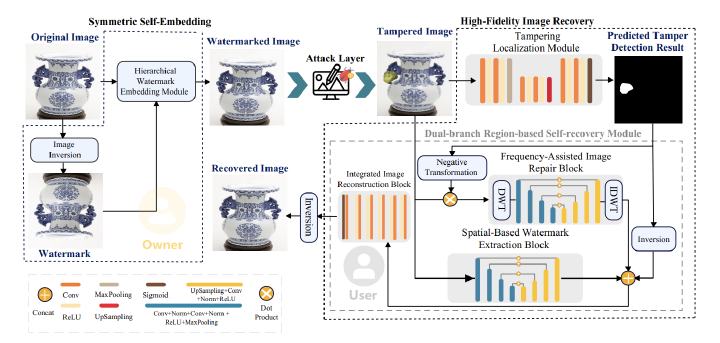
Digital images are inherently fragile and vulnerable to malicious tampering, significantly compromising their authenticity and integrity. Image recovery is crucial for restoring altered content and preserving the reliability of digital images. Traditional fragile watermarking methods achieve high-quality recovery but fail under post-processing attacks, while existing deep learning-based approaches offer some robustness, yet often produce lower-quality recovered images, typically with a PSNR of around 28 dB. To address these challenges, we propose a novel Symmetric Self-embedding Mechanism for High-Fidelity Image Recovery against tampering (SSEM-HIR), which is capable of restoring tampered images with high quality while maintaining some robustness against common attacks. Unlike existing methods that use the fragility of watermarking solely for tampering localization, SSEM-HIR is the first work to integrate fragility with spatial symmetry, enabling high-quality tampering recovery. Specifically, our SSEM-HIR employs a hierarchical watermark embedding module to embed an inverted version of the original image, utilizing spatial symmetry to retrieve lost information from the extracted watermark. To further improve recovery quality, we design a Dual-branch Region-based SelfRecovery module, where a Spatial-based Watermark Extraction block restores tampered regions using embedded watermark information, while a Frequency-assisted Image Repair block compensates for quality degradation in the untampered area. Extensive experiments show that our method achieves an average PSNR of 34.14 dB under common attack scenarios, including noise addition, image scaling, Gaussian blurring, and no postprocessing. This represents an improvement of over 5 dB and 18% in recovered image quality compared to state-of-the-art approaches.
Type
Publication
IEEE Transactions on Information Forensics and Security (JCR Q1, CCF A, 中科院1区 Top)